

10 Ways to Ensure Success from your Leadership Development Programme
Investing in a leadership development programme is a significant commitment. So how do you make sure it delivers a return?
 Most organisations invest in leadership development because they want better leadership to translate into better business results.
But a great programme on its own isn’t enough. The real value comes when new leadership skills and behaviours are applied back in the workplace – and sustained over time.
After many years of designing and delivering leadership development programmes, we’ve identified ten things that make a real difference.
1. Start with the business results you want
Before thinking about programme content, be clear about what you want to be different in the business as a result of developing your leaders. Perhaps you want to improve customer satisfaction, employee engagement, productivity, retention or sales.
Whatever the results you're looking for, make sure they connect directly to your organisation’s purpose, strategy, values – and identify how you will measure progress. This gives your programme a clear purpose and makes it much easier to demonstrate its value.
2. Identify the leadership behaviours that will deliver those results
Once you know what you want to achieve, ask:
“What do our leaders need to do differently to make this happen?”
A needs analysis is an important step to ensure your programme fills the 'gaps' between the current leadership capability of your participants and the skills and behaviours that need to be developed.
If your organisation has a leadership competency framework, this can be helpful as a foundation for identifying the gaps. A customised 360° review can then provide valuable insight into the strengths and development needs of your participants.
This information allows you to design your programme around real organisational needs, rather than simply selecting a collection of popular leadership topics.
3. Get your senior leaders visibly behind it
Senior leadership support is an important factor in the effectiveness and success of leadership development programmes. Leadership development needs to be seen as a business priority, not simply an HR or Learning and Development initiative.
Your CEO and senior leaders should actively communicate why the programme matters, participate in key events and demonstrate their support throughout the programme. Even simple conversations can make a difference:
- “How’s the programme going?”
- “What have you changed in the way you lead your team?”
- “What’s been your biggest lightbulb moment?”
Most importantly, senior leaders need to walk the talk by demonstrating the leadership behaviours they expect from others.
4. Bring in the right expertise
Don’t assume one facilitator needs to deliver every aspect of your programme. The best programmes draw on specialists who bring deep expertise in particular areas, along with a range of perspectives and facilitation styles.
Your programme provider should take responsibility for ensuring that all contributors work together seamlessly, so participants experience a coherent development journey, rather than a series of disconnected workshops.
5. Make participation something people want
Rather than simply telling your people leaders that they are required to attend, sell the opportunity. Help potential participants (and their managers) understand what’s in it for them, their teams and the organisation.
If you have the numbers, consider an application process where participants, together with their manager, explain why they want to take part and commit to the expectations of the programme.
When people actively choose to invest in their own development, engagement tends to be much stronger.
6. Make workplace application the priority
Learning's great, but if it stays in the classroom it has no value. Here’s the key question:
“What will participants actually do differently when they get back to work?”
Build as many opportunities as you can throughout the programme for participants to focus on the application of their learning. After all, that's the purpose of your investment.
Line managers have an especially important role here. They can provide encouragement, ask about progress, create opportunities to practise new skills and help participants reflect on their experiences.
7. Be clear about expectations
Don’t leave expectations until the first workshop. From the outset, be clear about what you expect from both participants and their line managers.
Participants might be expected to:
- attend and engage fully in all programme components
- actively participate in workplace coaching conversations
- share relevant learning with their teams
- apply new skills and behaviours at work between workshops
- reflect on what worked and what didn’t.
Line managers should understand their role too – including making time for coaching conversations, encouraging workplace application and supporting participants to attend all components of the programme.
When everyone knows what’s expected, everyone is more likely to contribute to the result.
8. Build coaching into the programme
 Coaching is one of the most effective ways to help people translate learning into changed behaviour.
You don’t necessarily need to provide every participant with an external coach. Ideally line managers should fill this role - it can be more effective and is a much more sustainable and cost-effective approach.
But don’t assume that managers already know how to coach. Many people think they are coaching when they are actually directing, advising or mentoring.
If you're going to use participant managers as coaches, it's important that they are equipped with effective workplace coaching skills so they can provide the best support for their participant. You may need to invest in a coaching workshop for managers in advance of the programme starting.
9. Encourage reflection and storytelling
Learning becomes much more powerful when people stop and think about what they have tried, what happened and what they learned from it. Moreover, effective leadership learning is personal and ongoing so it's important that leaders critically reflect on their own practice.
Build reflective practice into the programme from the beginning. Provide participants with a simple template to record their reflections and encourage them to discuss these with their manager, and create opportunities for participants to tell stories about what they’ve applied at work and the outcomes. This can become a regular feature of each workshop or group check-in.
Sharing stories helps participants learn from one another and makes workplace application visible. It also reinforces the idea that leadership development isn’t about getting the “right answer” in the classroom – it’s about experimenting, reflecting and continually improving.
10. Build in time between programme components
Don’t cram your leadership programme into a series of workshops delivered one after another. Give people time to learn, apply, reflect, discuss, adjust and apply again - and give line managers time to coach, encourage and support participants between workshops.
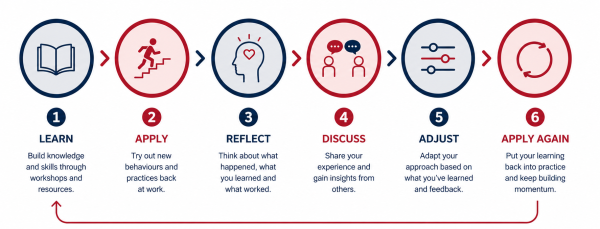
We recommend allowing 4–5 weeks between content workshops. The result is a development journey rather than a collection of training days. It creates space for participants to develop a continuous cycle of learning that drives lasting leadership change.
The space between workshops is part of the programme, not time when the programme stops.
The bottom line
Leadership development shouldn’t be measured by how much participants enjoyed the programme or how many workshops they attended. The real measure is what happens afterwards.
- Are leaders behaving differently?
- Are their teams experiencing better leadership?
- Are those changes contributing to the organisation’s identified business results?
Effective leadership development needs to go beyond great workshops. It needs to connect business results, leadership capability, workplace application, coaching, reflection and measurement. When those elements are deliberately built into the programme from the beginning, you’re much more likely to see a meaningful return on your investment.
If you’d like to explore how a well-designed and co-created leadership development programme can provide the business results you want, get in touch - we'd love to talk.
References
Mowat, J. W., Haar, J., & Forsyth, D. (2026). The impact of formal workplace coaching on employee outcomes: a matched sample analysis. Human Resource Development International.
Cameron, R.; Edwards, C.; Harper, G. (2024). Workplace Leadership Development Practices: An Environmental Scan.