

Psychometrics Matter More Than Ever in Senior Appointments
There’s a moment in every senior appointment process where the room goes quiet. The interviews are done, the references are in, the panel has compared notes … and yet something still feels uncertain.
It’s the moment when experience, instinct, and polished CVs stop being enough, and where the real risk lies. Because at senior levels, a poor appointment isn’t just a mis‑hire. It’s a cultural event. It shapes strategy, morale, and organisational trajectory for years.
This is exactly where psychometrics earn their place at the table.
For decades, HR professionals have known that relying solely on interviews, even structured ones, leaves too much to chance. And the research is unequivocal: cognitive ability and personality assessments remain two of the most reliable predictors of job performance available to us today.
A 2016 meta‑analysis by Schmidt, Oh & Shaffer confirmed that cognitive ability is the single strongest general predictor of job performance across industries and role levels[1]. But the real magic happens when cognitive data is paired with a robust personality profile, not to 'label' candidates, but to illuminate how they are likely to behave, lead, decide, and collaborate in the real world[2].
Why senior roles demand more than interviews can reveal
At senior levels, the stakes are different. You’re not just hiring for competence, you’re hiring for judgement, adaptability, influence, and the ability to lead through complexity.
Interviews, even well‑designed ones, are vulnerable to:
- impression management
- halo effects
- similarity bias
- over‑reliance on narrative skill
- misinterpretation of confidence as capability
Psychometrics don’t replace interviews, they correct for their blind spots. They give you a structured, evidence‑based lens on the two things that matter most in senior roles:
- How a leader thinks (cognitive ability)
- How a leader behaves (personality)
Together, they create a far more complete picture of leadership potential and risk.
Cognitive ability: the engine of adaptability
Cognitive assessments measure a leader’s capacity to:
- learn quickly
- solve unfamiliar problems
- process complexity
- make sound decisions under pressure
- adapt to changing conditions
This matters because senior roles are defined by ambiguity. The problems are novel, the variables shift, the information is incomplete. Research consistently shows that leaders with higher cognitive ability:
- ramp up faster
- make better strategic decisions
- navigate complexity more effectively
- are more responsive to training and development
- perform more consistently across contexts
This is why cognitive ability tools like SHL’s Verify suite, have remained the most validated predictor of job performance for over 100 years.
Personality: the operating system of leadership
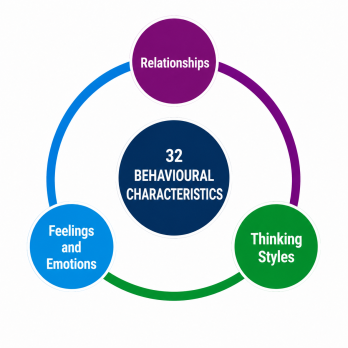 If cognitive ability is the engine, personality is the operating system. The SHL OPQ32, is the most widely used and researched personality assessment on the planet, measuring 32 behavioural characteristics across:
- Relationships with People (eg influence, sociability, empathy)
- Thinking Styles (eg analysis, creativity, structure)
- Feelings and Emotions (eg resilience, optimism, emotional control)
These traits shape how leaders:
- build trust
- influence stakeholders
- make decisions
- lead teams
- handle pressure
- drive change
- manage conflict
And critically, they reveal derailers, the patterns that don’t show up in interviews but absolutely show up in the job, eg:
- a highly conceptual leader who struggles with detail
- a persuasive, charismatic leader who avoids difficult conversations
- a resilient, tough‑minded leader who unintentionally shuts down dissent
- a structured, conscientious leader who becomes rigid under stress.
These aren’t flaws, they’re predictable behavioural patterns, and knowing them early allows organisations to make better decisions, shape onboarding, and design targeted development.
The evidence is clear, but so is the opportunity
Recent reviews of selection tool validity (eg Sackett et al, 2023) highlight that while structured interviews and work samples remain strong predictors, psychometrics continue to provide unique, incremental validity, significantly reducing the risk of poor hires, when combined with other methods. In other words, the best decisions come from combining methods, not choosing between them.
For HR, OD and P&C professionals, this is the opportunity to:
- lift selection conversations out of opinion and into evidence
- reduce the risk of costly mis‑hires
- support fair, defensible, bias‑resistant decision making
So what does this mean for you?
In a tight talent market, where every appointment matters, this is no longer optional. If you’re involved in senior appointments, ask yourself:
- Are we relying too heavily on interviews?
- Do we have objective data on how candidates think and behave?
- Are we identifying not just strengths, but potential derailers?
- Are we giving ourselves the best chance of making a great decision?
Psychometrics won’t make the decision for you, but they will make the decision better. And ultimately, they help ensure that the leaders you appoint are not just impressive on paper, but effective in practice.
If you’d like to explore how ODI uses tools like the OPQ personality and Verify cognitive assessments to support senior appointments, we’re always happy to have a conversation, to see how evidence-based methods can support your organisation’s future.
[1] The Validity and Utility of Selection Methods in Personnel Psychology: Practical and Theoretical Implications of 100 Years of Research Findings. (2016)
[2] Lievens, F., & Sackett, P. R. (2017). The effects of predictor method factors on selection outcomes: A modular approach to personnel selection procedures. Journal of Applied Psychology, 102(1), 43–66.