

EI Behaviours that Multiply Connection, Communication, and Collaboration
Strategy fails far less often than leadership behaviour does!
In today’s workplace, leaders are navigating increasing complexity: hybrid work, technological disruption, and constant organisational pressure. Yet many of the challenges leaders face are not primarily technical. They are human.
This is where emotional intelligence becomes essential.
Emotional intelligence refers to the skills people use to perceive, express, understand and manage emotions in themselves and others. These skills shape how effectively people connect, communicate and collaborate at work. They influence how leaders respond under pressure, how conversations unfold, and how decisions are made.
Importantly, emotional intelligence is not simply a personality trait. It is expressed through observable and developable workplace behaviours. The Genos emotional intelligence leadership framework identifies six core competencies expressed through observable behaviours that shape leadership effectiveness:
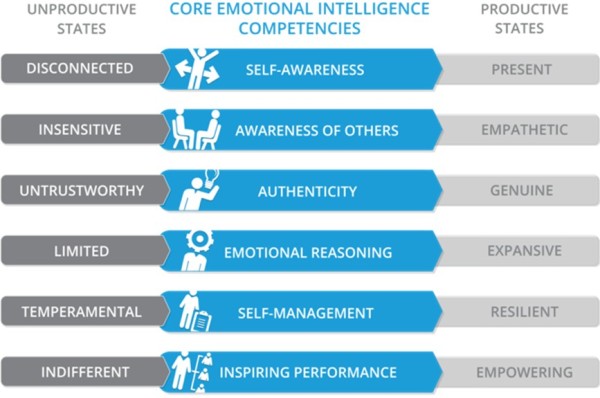
Together, these competencies influence how leaders show up in everyday moments of leadership, how they:
- understand their impact
- recognise and respond to others
- communicate openly
- integrate emotional information into decision-making
- manage themselves under pressure.
When demonstrated consistently, these competencies and associated behaviours create the conditions for others to perform at their best.
These behaviours are becoming even more important as the nature of work evolves. With automation, machine learning and AI continuing to take over routine and complex tasks, the human ability to connect, build trust, and create alignment becomes critical.
When EI behaviours are strong, we see the following:
- People speaking up earlier
- Feedback flowing more openly
- Trust growing within teams
- Collaboration becoming easier
When they are weak, the opposite tends to emerge:
- Conversations become more guarded
- Misunderstandings increase
- Psychological safety declines
- Collaboration slows or fractures
The encouraging news is that EI behaviours can be measured and developed. Behaviour-based EI assessments, including multi-rater (180 or 360 degree) feedback instruments, provide insight into how frequently leaders demonstrate emotionally intelligent behaviours and how those behaviours are experienced by others.
In leadership development, behaviour change is a metric that matters. Across Genos EI assessment programmes in New Zealand over the past 18 months, leaders have demonstrated an average 23% increase in emotionally intelligent leadership behaviours between initial assessment and follow-up measurement. These shifts are meaningful.
In a world where technical capability is abundant but human connection is increasingly strained, emotionally intelligent leadership may be one of the most practical and measurable levers available to strengthen organisational culture and performance.
Ultimately, the question for leaders and organisations becomes a simple but powerful one:
“What do people become around you?
More open, more courageous, more willing to contribute … or more guarded?”
The answer to that question reveals more about leadership impact than strategy ever will.
If you lead a team or are part of a senior leadership team and want to build your Emotional Intelligence, think about undergoing a Genos Emotional Intelligence 180 or 360 assessment, with targeted coaching or a tailored team workshop - Lead, Empower and Thrive with Emotional Intelligence